Wednesday 3 October 2012
We are committed to do God's work everywhere in the Rwandan community. The work ranges from prison ministry and community services including mainly unity and reconciliation, social, and economic development activities, counselling, construction of practical reconciliation villages (imidugudu), evangelism, teaching HIV/AIDS life skills such as sewing and weaving the traditional baskets etc.
 Thanks for your support and we look forward to continue this work a long with your support.

Thursday 12 July 2012
Research at PFR!
Since December, PFR is hosting Masahiro Minami, a Japanese Ph.D. candidate in counseling psychology from the University of British Columbia, Canada. Masahiro came to Rwanda to carry out a research, investigating possible effectiveness of a non-conventional approach to reconciliation, based on Japanese Morita Therapy. Traditionally, almost all psychological interventions are based on talking sessions in which problems are discussed. Conflicts are resolved by a trained mediator who leads discussions and mediate between two parties. The same applies to the current process of psychological reconciliation. An offender usually asks for forgiveness, a victim answers, and it is left up to whether the victim accepts or declines. The process takes place on a entirely verbal domain. Does this help make a real change within a person? Does it help the victim heal from trauma and the offender from guilt?
Masahiro, as a Registered Clinical Counselor in British Columbia, Canada, has a lot of experience delivering verbal mediation, and worked as a counselor/mediator for years. He is also trained and certified as an expert in Morita therapy by the Japanese Society for Morita Therapy. This organization promotes the therapy first developed in 1919 by the late Dr. Shoma Morita, a Japanese psychiatrist who explored the possibility of healing through “engagement in purposeful action”. To put it simply, it asserts that a change is brought about, not by talking, but by doing. Traditional Morita therapy has features similar to those of Zen, but has been applied exclusively outside of this context and frame of reference. It promotes an “obedience to nature” and what is natural. For example, Morita therapist considers that our feelings, being it pleasant (e.g., happiness) or unpleasant (e.g., sadness) as natural consequence of event/circumstance/situation. Feelings, as natural human capacity, we have no influence over its control, but we can observe and take them as they are. However, action is possible in spite of the feelings, and through this, we can incorporate our feeling-world into our life without interfering our daily activities. Morita therapists believe that the solution to a problem is not found in words and logical and rational discussions of a conflict, but in action, engagements in working and doing something together. In a case of a conflict between a teenage daughter and her mother, rather than discussing for hours whether it is true or not whether she has cleaned her room, they can clean the room together under the observation of a therapist in lieu of the discussion. Masahiro feels that this approach has been far more productive and also effective in conflict mediation according to his clinical experience.
Masahiro aims to try and apply the same Morita therapy principle in challenging field of reconciliation. He considers that the true reconciliation is not achieved by only a confession of guilt and a forgiving answer (in the best-case scenario, while in the worst, conversations and the process just get stuck with differing positions). Masahiro sees that under the verbal and forgiveness-seeking based approach, the offender, who has already taken so much from his victim, is asking further for yet another psychological resource from the victim. Masahiro aims to observe possible benefits of practical forgiveness-seeking. Under this approach, victims receive. Victims receive from the offenders through working together for the victims, sharing daily works of the victims, an approach identical to what PFR offers at 6 of their reconciliation villages. Through this join-labour for the victims, victims and offenders might be able to rediscover the reciprocal exchange of humanity and be closer and do something together, which is to live together again.
Is it possible to transform a relationship by an inter-action? According to the empirical studies conducted in the area of contact theory, the answer is yes. Meta analyses of the studies support that a prolonged contacts, meeting certain “contact conditions” are most likely to lead to positive attitude change towards each other. Not only the time spent together is beneficial for the victims, but also is for the offenders in a different light: by working in a concrete way to help the victim, offenders are given opportunities to atones for their deeds and to give concrete evidence of his good will. Action-based practical reconciliation approach never forces the victim into an acceptance or even acknowledgment of offender remorse and guilt before the services and atonements being done. It also promotes cooperation in a clearly delimited context with engagements in works of daily living (which has to be done anyway and therefore is not an activity foreign to the parties and existing only for the purpose of reconciliation). It leaves control to the survivor who chooses when, what and how to accept the offenders offer. Masahiro considers that the role of a mediator is therefore that of a witness who coordinates and facilitates the encounter without giving any answer or steering the direction and media (verbal or non-verbal) of the encounter.
Although this practical approach to reconciliation has been the one adopted by PFR throughout the past years to achieve unity and reconciliation, there has not been any actual quantitative or qualitative research conducted about it and on how much this approach brings about healing and positive changes in attitudes within the communities. If the results of Masahiro's research are positive, they will provide strong empirical as well as theoretical backbone to the works PFR has already been doing. It will offer scientific support to our work and give us further affirmation and determination to carry on with our work. It will also provide us with empirical evidence with which to seek for further support.
We will keep you informed of his research progress and the results!
 |
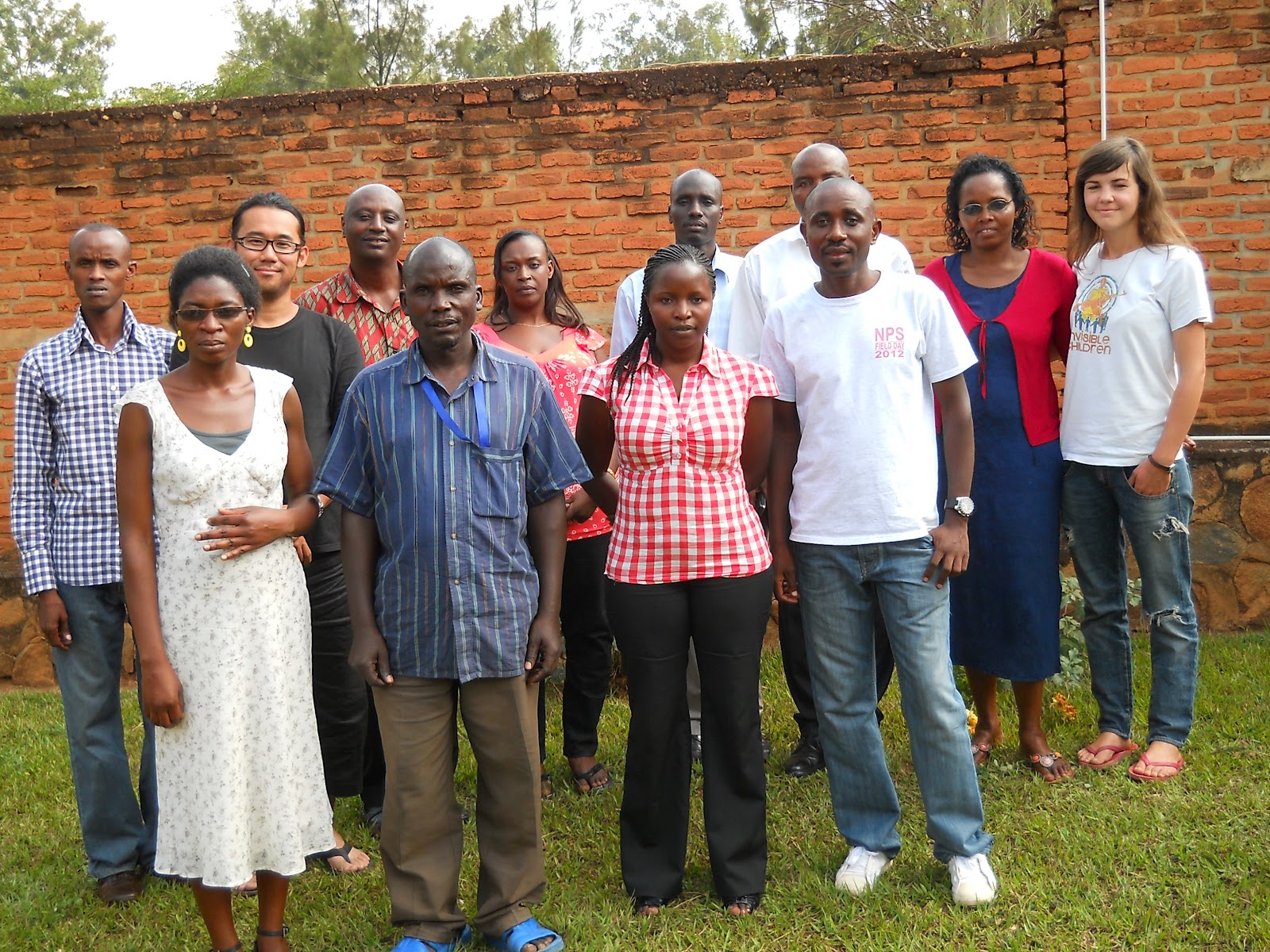
| Masahiro (in the middle) with the PFR team! |
Recently, Masahiro has founded, together with Bishop John Rucyahan and Pastor Deo Gashagaza, and been appointed as the director of PFR-Morita Centre for Peace and Reconciliation Research.
For more information of his research and the research centre, and to discover how you could help, visit www.pfrwanda.org!
Friday 16 March 2012
Meet our women, one story at a time

Abihigira Godelirwa : 35 years old, single mother of three
Abihigira is a mother to three children: Joyeuse (12), Angelique(11), and Rodrigue (9 and her only boy). All started to attend Primary school just a few years ago, when she became able to pay the fees - partially thanks to our women’s cooperative, which she joined in 2006.
As many of the other women, she lost her husband, the father of her children, to AIDS, in 2004, two years after she discovered that she too had contracted the illness.
She is originally from Muhanga, in the South of Rwanda, but she came to Kigali in 1999 to marry her late husband.
Her family can hardly support her- from the chaos of the genocide and its aftermath, only Abihigira and her mother came out alive. She is Hutu: but the war did not spare her family. Afraid from the killings and the ongoing madness, she hid away with her siblings in the fields, until the end of the killings, while her mother went out looking for food every night and moving her children to different places, trying to save their lives.
Her father and her brother where not in her hometown at the time of the genocide, but in Kigali. Her brother, 27 years old, was shot on the street, and she never found out why. Her father was killed shortly after, sometime between 1994 and 1995 in Kigali: reason, place and time are still a mystery to everyone but his killers.
Now she lives alone with her children, and earns her life walking every day for miles and miles, selling fruit and vegetables on the street- if she's lucky, she manages to get between 500 and 1000 rwandan francs a day (on the best of days this means less than $1.60, €1.20 or £1.00)

Selephine Kagaju : 52 years old, single mother of five
Selephine comes to the PFR office twice a week to learn to sew with a group of women who have similar problems to herself: widowed and HIV-positive, she has five children to care for, Irene (25), Hakizimana (22), Pascal (19), Consolé (13), and the adopted Ndahiro (13, who came into the family after Selephine's little sister's death).
The women sit together, working and chatting, trying to find a way out of their problems and a way into hope. Twice a week, from 8am to 2pm, under the supervision of their teacher Betty, they learn to sew, something which will hopefully allow them to create a better and dignified life for themselves and their children.
Selephine's husband, Corneille, whom she married in 1979, died of AIDS in 2005. He had been working as an accountant in Kigali, where they had met during Selephine’s studies (she is originally from Nyamata, in Bugesera district).
Two of their children had already preceded him in death during the genocide. Corneille was Hutu, but Selephine was a Tutsi. He managed to hide her and the children, but the two older ones fled when the killers arrived, and were mercilessly killed on the open street.
Now she is alone, raising the five children left, and life is hard on her.
Her children are nearly adults now, but as she could not always afford to pay for their studies, the older ones are still in high school, and she struggles to pay the school fees, which are 65.000 Rwandan Francs for trimester (110 US dollars).
“I dream that my children will be able to complete their studies. I'd love so much to see them finishing school and find a job. Be able to live, like anyone.”
Let's hope that this will not stay a dream- you could support Selephine, Abihigira and the other ladies in our cooperative by buying their products.
For more information about the products and how you could help, please feel free to contact us at info@pfrwanda.org!
Monday 13 February 2012
A woman in Rwanda
Working at PFR is full of adjectives.
It is challenging. Changing. Multilingual. Smiling. Emotional. Overwhelming. Tiring. Funny. Thrilling.
Every day brings something and someone different: a visit from a pastor, who needs help to get an authorization to enter a prison, the kids who jump on your lap while you're trying to write a proposal, a conversation with the guard who just discovered you master a few words of Swahili, a psychologist from the U. S. who is helping people to overcome their trauma...
Every day is unlike the previous one, and most of the time it's interesting.
Only sometimes it becomes difficult.
It was Monday morning, and I was going to finish writing a presentation of our projects, when Guma, our Communication Manager, called me and asked me to interview some of our HIV+ widows from the cooperative, who come every week to learn to sew and make other handicrafts.
I did not realize at first how challenging that would be...
Most of these womens are in a really difficult life situation. Widows, with many children, HIV+ positive, and really poor.
To make an interview means that you have to ask a lot of tough questions, of really personal details.
And you don't have only to ask the questions- you have also to listen to the answers.
She looks proud and strong when she walks into the office.
Philomene is a woman who has had a very difficult life, but meeting her for the first time, you would never know it.
When asked if she is married, she answers the question with a swipe of the hand, as if to say “it is all gone now”.
Philomene was born in Rurindo district, in the North of Rwanda, in 1967. She lived on a little farm, with her parents and her seven brothers and sisters, until she married to a man from the neighborhood. Life might have been peaceful with their little son, but genocide struck and put an end to all normality.
1994:
Of her seven siblings, only one survived.
Her parents and relatives were killed.
Her husband was murdered, and their only son, three years old, with him.
She survived, by sheer luck: she just had had a miscarriage and could not walk. While the rest of her family fled on the roads of Rwanda, trying to avoid the killers, she stayed behind, too weak to flee.
Hiding in the forest near her home for three months, she somehow escaped death, but had to pay a high price- all of her family dead, all the hopes for the future shattered, and “the illness” as an eternal companion for the rest of her life.
“AIDS? I got it from the war.”
“AIDS? I got it from the war.”

The Rwandan Patriotic Front, Kagame's soldiers, found her bereft of all strength in the forest and brought her to Byumba, where they provided her with medicine and financial help.
She tried to forget the past, to start a new life and in 1995 she married again, to a mechanic from her home town, Celeste Machumi, and moved to Kigali with him.
They had three children together: André(15), Juona(10), and Patrick(7). But ten years later, tragedy struck again and in a twist of cruel irony, Philomene lost her second husband to AIDS- a last, untimely toll to genocide.
Now her daily life is a struggle. She finds it difficult to pay for school but tries hard to provide her children with a good education. They deserve to find a job and earn a living, to be able to build a better future for themselves. So she walks in the streets every day, from house to house, and tries to sell some meat, some fruits, some little things. There is a little bit of hope in every sale she makes.
She started coming to PFR in 2006, and has been making small handicrafts out of banana leaf with the other women. This allows her some extra income and now that she is learning to sew at the office she hopes she will soon be able to start her own small business.
Philomene is only one of a thousand similar and terrible stories.
And still, in all the difficulty of their lives, these women have gone on, and are a true source of inspiration. They'll always find tome for a smile, a word to share with their friends at the cooperative, the courage to look for a way out of their problems and for hope in the pit of their memories.
They are strong, and are following the path of reconciliation and forgiveness, notwithstanding how hard that can be.
In the words of Serephine, one of Philomene's friends at the cooperative:
"I was bitter after what happened to me in the genocide. There was a time when I refused to speak with people at all. I trusted no one. In fact, I hated other people. I feared them. I was suspicious. I found myself wondering whether reconciliation was even possible.
I wanted to know more about it. Some friends told me about Prison Fellowship Rwanda. I found out
that PFR offered trainings in unity and reconciliation, counseling, and teachings about God.
What’s most important about reconciliation is the knowledge that any other person I see is the same as I am and deserves to be treated with dignity, just like I do. We have similar needs. We are all created the same.
After I accepted this, I began to view other people in an entirely different way. I feel not bitter anymore.
I am now moving forward. I aim to work hard in everything I do. We still live in extreme poverty, but I pray that God will provide for my children and the children of my children."
Listening to their stories is not easy.
If you would like to support them-
-if you want to have some of the handicraft product our women make-
-or if you know where to sell them-
please let us know at info@pfrwanda.org!
Thank you!!"I was bitter after what happened to me in the genocide. There was a time when I refused to speak with people at all. I trusted no one. In fact, I hated other people. I feared them. I was suspicious. I found myself wondering whether reconciliation was even possible.
I wanted to know more about it. Some friends told me about Prison Fellowship Rwanda. I found out
that PFR offered trainings in unity and reconciliation, counseling, and teachings about God.
What’s most important about reconciliation is the knowledge that any other person I see is the same as I am and deserves to be treated with dignity, just like I do. We have similar needs. We are all created the same.
After I accepted this, I began to view other people in an entirely different way. I feel not bitter anymore.
I am now moving forward. I aim to work hard in everything I do. We still live in extreme poverty, but I pray that God will provide for my children and the children of my children."
Listening to their stories is not easy.
Living them, is- luckily for us- beyond our ability of real comprehension.
But helping these women- we try to do it, and we can do it.
If you would like to support them-
-if you want to have some of the handicraft product our women make-
-or if you know where to sell them-
please let us know at info@pfrwanda.org!
Thursday 15 December 2011
Hard to say goodbye
I have been interning at PFR for the last six months and with a week left to go you can imagine the building excitement of going home and being reunited with my friends and family. But last night it finally hit me, I am leaving behind another family. Over a leaving dinner at our favourite local restaurant sharing the usual jokes, brainstorming new ideas with Guma (my boss and PFR’s Communication Director), and tucking into a delicious meal, every member of the PFR team stood up a told me what I had meant to them. It was without a doubt one of the most touching evenings of my life, and why am I telling you this? Quite simply to allow myself the opportunity to put into words what this organisation means to me and why they are so worthy of your support. So how do I summarise the past six months without sending everyone to sleep? In three words...spirit, dedication, and love.
Spirit
The PFR team have an unbreakable spirit, and when confronted with the numerous challenges they face they are not discouraged. They talk problems through in fast-paced Kinyarwandan (which then gets translated for yours truly) and everybody gets a say. They are some of the hardest workers I have ever met, finding time in their busy schedules to not only take care of families, but to attend prayer daily, to work 10 hour days, and even make time to socialise with one another...demonstrated by the fact that despite the birth of a new baby boy for our Project Manager Felix (congratulations!) he still made an appearance at my leaving dinner. You would think that with all this going on the office environment might, on occasion, be a little tense, with tired and irritable workers...I’m picturing a typical London office come Monday morning, but no, it’s smiles all round, constant upbeat chatter, and a ‘ready to face whatever is thrown at me mentality’, sometimes it’s hard to keep up! You certainly need a lot of what follows to maintain this incredible spirit...
Dedication
PFR’s dedication to the causes it supports is inspirational. I honestly think that if no money was available, some of the staff would offer their time for free. It is refreshing to work in an environment where everyone is genuinely passionate about what they do, and the people they are championing....our HIV + women, the street children of the AAC, communities going through the long process of reconciliation, or prisoners who are repenting for their crimes. Every group and every person counts. Sometimes I wonder if PFR tries to do too much, to support too many people (this is normally when I am overwhelmed with tasks myself) but then I remember that everything they have accomplished so far...the six successful reconciliation villages, the 33 child sponsorships, the marketing of women’s goods, and the evangelising of once hopeless prisoners, proves that they can succeed at whatever they set their mind to. And moreover, they cannot say no, or turn away someone in need. And this leads me to my last point...
Love
When you walk into the PFR office, whether as an old friend, business partner, or new acquaintance, you are greeted with a warm embrace from Jacqueline, and you instantly ‘feel the love’. Suddenly your language, your skin colour, your different culture, disappears into thin air and you are just another person, which is rather refreshing when you are having to adjust to getting stared at on a daily basis and chased by small children. In my time with PFR I have been described as many things but what I will remember most is being described as a daughter by our Executive Director Pastor Deo, who not only ensures I get the best treatment when sick (which inevitably happens rather a lot over here) but also offered me a room in his family home when he found out I was paying an extortionate rent. The staff show their love to me and to one another in so many different ways...from an invite to a family wedding, to visiting a new born baby in hospital. From teasing one another about boyfriends or girlfriends (sorry ‘secret friends’), to all chipping in to help someone pay rent on a new house. It is a pleasure to work with such wonderful, warm, and loving people. I will treasure every moment.
So there you have it. Three words that should assure you that supporting PFR is a wise decision. The team will work tirelessly to ensure your money is spent in all the right ways, no project or new idea is too much for them, and not only do they truly appreciate the kindness you show them but they will welcome you to Rwanda and into the office with open arms and hearts. To support us or share ideas with us please email info@pfrwanda.org.
Thursday 1 December 2011
One Man's Story
Those of you who have had the pleasure to spend time with PFR’s Founder and Executive Director Pastor Deo Gashagaza may have already been rendered speechless by his amazing and inspirational story. For those that haven’t had this opportunity Pastor Deo has been persuaded to put pen to paper and begin to write it, in the hope that this may one day lead to an entire book, his stories could certainly fill one...
‘I was born in the Democratic Republic of Congo in 1963. My parents had fled there from Rwanda during the massacres of 1959. Many members of my family did not make the same choice, they stayed in Rwanda. It was their home and they did not want to leave. I first saw Rwanda, a country that I had grown up hearing about, in 1995, in the wake of the 1994 genocide. After 32 years of living as a refugee I had come ‘home’, to a country that was devastated. Personally I was going through a lot of trauma, 45 members of my family had been murdered, including my sister who had returned to Rwanda prior to the genocide. She had been killed in the southern province of Bugesera where she was living with her family. I don’t know why but I felt that this is where I needed to go, maybe in the search for answers and for closure. Whatever it was, it led me to Bugesera prison where those who had killed her would be being held. I asked to enter the prison as a Pastor to speak to the inmates about the word of God, it was something they needed to hear. They had committed the most horrendous crimes but they were still people, and I still saw them as people.

Pastor Deo telling his story for an exciting documentary
I was the first Pastor to be permitted entry. The genocide had finished not so long ago and genocide ideology was still fresh in many perpetrators minds, some justifying their actions to themselves, others to try to save themselves from punishment. When I walked in many of the prisoners took one look at me and asked ‘why is he still alive, this Tutsi?’ others said ‘we should finish him off.’ I was terrified, shaking, sure that I was going to die and asking why God had wanted me to do this, just to be killed like all the other members of my family. There were so many prisoners, and so few guards that really if they wanted to kill me they could do so easily. After much discussion the prisoners that seemed incharge decided that they would let me speak first, and kill me after. This was really my one chance, I had no other option, so I began to speak. I told them that God loved them no matter what they had done, I spoke to them about sin, confession, repentance and hope. I asked them to have faith that this was not the end of their lives, that the damage they had caused could be mended and that maybe once again they could return to their families, their villages, and live a normal life again. I did not trivialise their crimes, but I wanted them to know that with time, and with work that maybe one day they could be forgiven, if they really understood the error of their ways, and were truly and deeply sorry for what they had done. They needed to understand that we are all sinners, nobody is perfect, and whilst yes their crimes were to many, incomprehensible, if I could find it in my heart to talk to them and perhaps even one day forgive the very people that had killed my own sister, then I thought that maybe others could too.
When the moment came for me to finish I was so scared, I wanted to go on talking forever, but I knew that if I was killed then it was doing something that I believed passionately in. So I finished, and to my great surprise many prisoners began to approach me, hug me, shake my hand, some were in tears. They asked me to come back again, to tell them more stories from the Bible, to teach them to word of God. Of course I was overwhelmed with happiness and agreed to come back the following week. I had put my life in God’s hands and he had protected me, my faith was stronger than ever.’

Today Deo takes his message around the globe
If after reading this you simply think it is unbelievable then trust me I know the feeling. When Pastor Deo first told me his story I could not even respond, I had so many questions...why would you put your life at risk when you had escaped the genocide? How could you bear to be in the same room as people that had killed members of your own family? Did he really think they could be forgiven? But I knew what the answer would be to every question...everything is in God’s hands. Pastor Deo is a deeply spiritual man and he seeps kindness. Just being in his presence makes you feel good and loved, so really it should come as no surprise that he offered this incredible level of compassion to the prisoners of Bugesera. PFR today owes everything to Pastor Deo and to this first brave venture into Bugesera prison.
Monday 21 November 2011
The Word on Everyone's Lips: Reconciliation
A word closely associated with Rwanda today is 'reconciliation', but what does this really mean and how does one go about achieving it? As it turns out, PFR's Project Manager Felix is the man to ask.
Felix runs restorative justice workshops in communities around Rwanda and last week he journeyed to Ntarama in the district of Bugesera to conduct a three day workshop.Ntarama is an area renowned for some of the most brutal killings of the 1994 Rwandan genocide. Over 5000 Tutsis, including many women and children fled for shelter in the local church, but they did not find sanctuary. Instead they died huddling together whilst Hutu militias threw grenades into the crowd and then finished survivors off with machetes and rifles.


Despite the pouring rain over 40 participants showed up from many different districts to take part in this workshop which is vital to maintaining peaceful and healthy relationships between members of different communities.The aim of the workshop was to teach the participants how to become conflict mediators in their own communities and whilst it is impossible to describe in detail the amount of information covered in this comprehensive three day course, below I will highlight what I took to be the most important aspects and the bible teachings Felix used to make them accessible to the participants.

Felix teaching
WHAT IS RECONCILIATION?
First and foremost...reconciliation is a process not an event, there is no magic formula. We cannot expect it to happen overnight, or in one meeting. Relationships must be constantly worked on. Reconciliation is the building of a friendship and replacing hatred with love. Building a friendship in even the best of circumstances takes time, and building a friendship between two people who have previously hated each other will take much longer.
Furthermore, a reconciled relationship must be built according to the words of John Chapter 3, Verse 18 “Little children, let us not love in word or speech but in deed and in truth.” It is through actions that we build true and lasting relationships.
Felix told the participants that their motto should be ‘Gukunda, Ubushuti, and Amahoro’ or ‘Love, Friendship and Peace’...the first to two together leading to the accomplishment of the latter.

Brainstorming the meaning of reconciliation
WHY SHOULD IT BE PURSUED?
Reconciliation is not only about achieving peace between two parties. Whilst this is of course important in itself what is even more important is maintaining peace in the general community by resolving the smaller conflicts that arise. First Corinthians Chapter 10, Verse 31 tells us “So whether you eat or drink or whatever you do, do it all for the glory of God.” As Christians we have a duty to pursue reconciliation and peaceful relations not just for our own glory but for the glory of God.

The perfect student!
HOW IT SHOULD BE PURSUED...
Firstly, in order to be successful in reconciling two parties you should not enter as a judge, you must learn to be humble and listen as another human being, a human being that has sinned just like others. Matthew Chapter 7, Verse 5 tells us ‘Hypocrite! First get rid of the log in your own eye; then you will see well enough to deal with the speck in your friend's eye.’ So before you can act as a conflict mediator, Felix tells participants that they must address their own shortcomings, that they must not be righteous, but be understanding. We are all the same.
Secondly, you must build a relationship of trust between yourself, the mediator, and the parties involved in the conflict. This will take time and nurturing, you must speak to each party separately about how they are feeling and encourage them to be open and candid with their emotions. That way, when they speak to one another they will hopefully maintain this openness and the trust you have built with both parties will allow you to be seen as a neutral mediator.

Group discussion
WHEN PROBLEMS ARISE...
Reconciliation is by no means easy. Frustration, fear, and hatred stand in the way of open discussion and co-operation. People will avoid facing the truth as often it is simply too painful. Felix asked one of the participants to give an example. A smartly dressed woman stood up to address us and told us how she had been sexually violated and injured by a man in her village during the genocide. He had left her for dead, presuming she would not survive the terrible injuries he had inflicted on her private parts using numerous weapons. However, not only did she survive, but somehow she found it in her heart to forgive this man. She told us that she needed to forgive to move on with her own life, she understood that fostering resentment and hate was only going to hold her back. She thought that making this brave decision would mark a new beginning for her. The problem arose however when the man in question would not accept her forgiveness, he could not believe that anyone could truly forgive such atrocities. So now she stands in no-mans land, wanting desperately to forgive and move on with her life, yet unable to because of the very man who inflicted so much physical and emotional pain on her to begin with.

A very brave lady willing to forgive the man that tortured her
Felix encouraged the woman to try, as hard and as unfair as it might seem, to view the situation from the man’s perspective. He asked an ex-prisoner to stand up and explain the kind of feelings that genocide perpetrators experience when confronted by their victims. The ex-prisoner described a sense of overwhelming shame, of their own trauma remembering the pain they had inflicted, and the killing that went on all around them. He said that often perpetrators believe the sins they have committed to be beyond comprehension, and therefore beyond forgiveness. He went on to say that the only way that he overcame this was to help the victims in day to day life, helping to build their house, farm their land, carry their water and so on. Felix asked her and members of her community to try this approach with the man who violated her. Time is a great healer, and practical reconciliation we are told time and time again by perpetrators and survivors is the only way to repair shattered relationships.
It was a great experience to be able to watch restorative justice in action, and whilst some of the testimonies were truly harrowing it was incredibly moving to hear that these people wanted to move on with their lives and were prepared to offer true forgiveness. The participants of these workshops are vital to the future of Rwanda and their commitment to becoming conflict mediators in their own communities is inspirational. I hope to have shared a little of what I learned about reconciliation one rainy day in Ntarama.
Subscribe to:
Posts (Atom)