Friday, 15 October 2010

15 Youth Who Have Been Living on the Streets Since the Genocide Celebrate Send-Off to Vocational School!

Thanks to the generosity of several supporters of Prison Fellowship Rwanda’s program for street children, 15 young adults (12 boys and 3 girls) who have spent the majority of their lives living in extreme poverty on the streets of Kigali spent the morning of October 4, 2010 celebrating their send-off to vocational school. Due to the demands they faced on the streets, they were forced to drop out of school very early – most commonly during their primary school years. Prison Fellowship has served these children, ranging in age from 16 to 21 years of age, for 3 years.

Most of these children were orphaned after losing both of their parents during the Rwandan genocide in 1994; others live at home in extreme poverty with one parent and have been forced to fend for themselves on the streets. PFR loaded 15 mattresses onto a truck and the children, bathed and given fresh new clothes, piled into a van cheering and saying, “Bye, streets!” as they were transported about 2 hours outside of Kigali to Amizero Training Centre.

School staff greeted the children warmly, many photos were taken, enthusiastic words were exchanged, and the children began to settle into their dormitories. At the vocational school, these children will learn valuable skills that will build stable and successful futures. They can choose to participate in training for a wide variety of skill sets, including: tailoring, cloth-cutting, carpentry, construction, welding, fabrication, hotel operations, or livestock and crop management.

Founded in 2003 by the umbrella not-for-profit organization Rwanda Rural Rehabilitation Initiative (RWARRI), the Amerizo Training Centre (ATC) seeks to help Rwandans combat the widespread poverty that has ensued from the loss of property and dignity spurred on by the genocide. To accomplish this goal, ATC not only offers hands-on skills training, but also by ensures that the vocations of interest will rebuild and rehabilitate the nation. Houses can be rebuilt, farmland can be renewed, and the market economy can be restored.

The young men and women will spend 6 months at ATC and will be in contact with PFR throughout their experience. After training, they will enter the work force with a greater sense of self-worth, useful skills, and new knowledge to contribute to Rwanda’s social and economic progress.

Currently, PF Rwanda is working to grow its programs for street children. As of now, street children of many ages come to the PFR office three times per week, where they receive hot meals, baths, bible teachings, counseling, and where they can participate in activities such as basketball. PFR’s long-term vision is to create a home for these children, where they can build a sense of family, attend school, and hear about God’s love for them on a daily basis.

Areas of need:

>Prayer for the endurance, development, and growth of the street children program

>Funding for:

· The construction and staffing of a new home and school to serve street children throughout Rwanda

· Balanced meals

· Materials for bible teachings and counseling

· Clothing

· Sports/outdoor activities

· Water and soap for baths

You can find out more about the street children’s program online at:

http://prisonfellowshiprwanda.blogspot.com

To learn more and participate in PF Rwanda's initiatives, join the PF Rwanda Facebook Group.

To get updates, view photos, and keep in touch with Rwandan street children, join "Prison Fellowship Rwanda's Forum for Street Children & Youth," a Facebook group dedicated specifically to PF Rwanda's programs for these young people.

Monday, 20 September 2010


HIV women who are supported by PFR through counselling and help to train them in different income generating activities are now happy again for another initiative.

PFR after training the women in beautiful traditional baskets, earrings and other items, has now switched to train them in tailoring skills.

PFR believe that with various skills they can now able work and earn money to help take care of themeselves. PFR thanks different supportors to make this happen.
PFR can not forget to say big thanks to Nancy Strachan of RWANDA HUGS-HELP US GET STARTED.

The first group of 11 women has started for six months opening the way to another group.

Monday, 2 August 2010

Welcomed Guests

This month Prison Fellowship Rwanda (PFR) was fortunate enough to host over 20 visitors for two days at the PFR office! Mark Phillips, a member of our US Board that fundraises for PFR in the USA arrived in Kigali with his church group from West Virginia. They were greeted at the airport by Pastor Deo and taken to the Kigali Memorial Centre before visiting one of our reconciliation villages in the Eastern Province. They arrived at the PFR office on Monday afternoon and were welcomed with excited singing and some traditional Rwandan dancing from the children and women that we serve. There were over 150 people in the office grounds!

The team donate footballs to one of PFR's Reconciliation Villages before making their way to the office

The younger members of the group spent the afternoons entertaining the children, all of whom were overjoyed to have so many visitors, whilst the others worked with PFR staff members to begin making a permanent record of each child starting with the youngest first. We hope that this will not only allow the PFR office to learn more about the children, but also that it will enable us to raise more funds to support them. From September onwards, PFR will no longer have the finances available to continue to feed the children three times a week and we are desperately seeking resources to enable us to keep this up. The group offered us continuing support in this project and we are extremely grateful.

The kids wait patiently whilst PFR staff explain that the group would like to interview 20 of the youngest children in hope of getting donations to support them in the future

During their stay with PFR, the Falls Church Group also donated clothes to every child, a brilliant demonstration of the kind of physical support we are encouraging all visitors to provide. Every child was given at least two items of clothing and shoes were also given to those who needed them most. The children were so excited to be receiving clothes that were in such good condition and by the end of the day some of them looked very smart indeed. It was truly wonderful to see two groups of young people who have lived such different lives getting along so easily and even exchanging email addresses.

Our visitors help the kids to choose new clothes, each child received at least two items and shoes were given to those who needed them most.

Finally, progress was also made towards improving the marketable of the goods made by the HIV/AIDS women that PFR serves. Having already received a donation offer of 20 manual sewing machines from UK Charity ‘Tools for Self Reliance’, PFR hopes to work closely with the US Board to brainstorm ideas of sewn products that can be easily shipped to the USA to be sold. Whilst we have already come up with a few ideas, we would be grateful for any input you could give us so please do not hesitate to email us at info@pfrwanda.org with any thoughts and suggestions. Thank you once again to our visitors and we hope to see them again soon.

Friday, 25 June 2010

Restorative Justice in the Community

This month, Prison Fellowship Rwanda (PFR) conducted its fifth ‘Restorative Justice’ three-day training workshop, this time in Juru Sector, Bugasera District, Eastern Province. The class was made up of 15 participants, half of which were genocide victims, half ex-offenders and a handful of local authority members. The aim of the class was to promote continuing unity and reconciliation, and sustainable peaceful cohabitation within communities. By training participants to become peace activists, PFR hoped that they would continue to mobilise others in their respective communities in the prevention and resolution of any conflict that might arise.

The first day started with a brief presentation by each attendee stating their name, job, and where they came from originally. There was a colourful mix of backgrounds in attendance showing the diversity of people that the reconciliation villages encompass and demonstrating the miraculous feat that has already been accomplished in maintaining peaceful living environments. PFR’s project manager, Felix, then asked participants to begin by contemplating why exactly they were all there, concluding that the reason the workshop was being conducted was to fix something that had been broken (faith, unity, trust), to continue to bring people together after the 1994 conflict, and to understand what they had all lived through. Throughout the course of the day, participants answered and discussed further topics including the definition of conflict, the origins and impact of the 1994 conflict, and the meaning of true reconciliation. These discussions provoked thoughtful responses from the group and enabled them to gain an understanding of the problems they might face.

PFR's Project Manager, Felix, leads the workshop

The aim of the second day was to address methods of conflict prevention and resolution. Many different ideas were shared including the importance of dialogue with a mediator, allowing concerned parties to express themselves and come to an agreement. This addressed low-level conflict such as family conflict. At a community level it was concluded that law could be used in the prevention of conflict, within organisations and co-operatives rules could be written and used to govern behaviour in times of conflict, or if necessary the local authorities could become involved. Finally, on a national level it was suggested that force could be used to prevent or resolve conflict, although all agreed this was a last resort, and that it was much better to resolve conflict before it had the chance to escalate.

Men and women listen attentively before discussing their ideas

On the third day, participants discussed the merits of using restorative justice instead of classical jurisdiction. By the end of the day it was clear that participants understood the vital difference between the two methods. In classical jurisdiction, concerned parties are not involved in the resolution process, decisions are taken by lawyers and often not welcomed by the people involved. This prevents the concerned parties from building a lasting social relationship. In restorative justice however, the concerned parties express their points of view and whilst the mediator does lead the dialogue, he does not take sides. The two people are made to work together, to find their own solution, and to reach an agreement that they are both happy with and therefore creating a solid, sustainable social relationship.

During the three-day workshop, several participants also gave testimonies that demonstrated the continuing success of reconciliation and unity programmes conducted by PFR. One ex-offender described the internal struggle he had faced in deciding to confess his crimes. On the one hand he had the burden of shame and guilt and on the other he was fearful of the impact that telling the truth would have either in death or in a life prison sentence. After attending many reconciliation and unity workshops in prison, he came to the realisation that the only way he would be at peace would be to confess and repent the genocide crimes he had committed. God answered his prayers, and shortly after his confession, the President issued a decree stating that all prisoners who had confessed would be released. His release into the community in 2003 was not easy, and he was afraid to meet with his victim’s families but PFR’s follow-up policy enabled him to gradually build up the courage to meet with the widow of a man he had killed and then to continue meeting with other families. This gave him the chance to tell them the full truth and to say how truly sorry he was. Not only did this allow him a sense of inner peace but a testimony from the widow demonstrated the benefit for genocide-survivors. She too had attended many reconciliation and unity workshops, but within the community, and it had taken a long time for her to realise that despite the bitterness in her heart, the only way she could live peacefully again with another ethnic group (Hutu) was to grant forgiveness to her husband’s killer. When she first arrived in the village she viewed all Hutus as killers, and that all had been involved in the murder of Tutsis but now she says she realises that it was the pain and anger she was holding on to that had led her to this conclusion. By meeting her husband’s murderer not only could she learn the whole truth, but she could also understand that it was just one man that killed her loved one, and now she lives, shares with, and helps all her community members. By helping these two people to come together, PFR demonstrated the overwhelming power of restorative justice.

Participants sing hymns on the completion of their three-day workshop

PFR will continue conducting workshops in September, and with Pastor Deo’s month-long restorative justice training course under his belt, we can expect continuing success. If you would like any more information or would like to help us in our efforts to promote reconciliation and unity throughout Rwanda please visit our website at www.pfrwanda.org or email us at info@pfrwanda.org.

Thursday, 17 June 2010

A Special Thank You


This week Prison Fellowship Rwanda (PFR) said goodbye to our dear friends and partners, International Reconciliation Ministry (IRM). Their parting was bitter-sweet as although it is never easy to see people go, the team left having accomplished a great deal in the three weeks they spent with us in Rwanda. We look forward to them joining us again in the future to continue their work, but for now let us tell you about just some of their achievements, highlighting the benefits that accrue from strong, and long-lasting partnerships.

Pastor Deo poses for one last photo with Arlene and Roger after the PFR staff and IRM team share a final meal together

During their stay the IRM team visited many of the prisons in Rwanda including Rilima, Musanze, Butare, and Nsinda. In these prisons, Arlene, IRM’s founder, conducted mass preaching sessions incorporating messages of transformation and reconciliation. These teachings are a vital part of prisoner transformation, as demonstrated by one of PFR’s own staff members and ex-prisoner Sekamana Jean de Dieu who gave his testimony to IRM.

Sekamana explained to the IRM team that after being imprisoned for genocide atrocities, Pastor Deo and the other servants of God that started visiting prisoners in 1995 opened his eyes to the sins he had committed and he began to repent.

IRM also distributed Bibles in order to enable the prisoners to learn and read the word of God for themselves. In Rilima Prison, the male members of the team, Jon and Pastor Roger conducted pastor training and at the end were able to reward 77 participants with certifications! Not only does this provide those trained with hope for future employment, but it also allows them to spread the word of God to other inmates when it is not possible for outsiders to visit. Furthermore, preaching was not confined to the prisons, the team spread messages of healing, forgiveness and unity in Kimonyi Reconciliation village to over 200 village members encouraging them to live and work together peacefully.

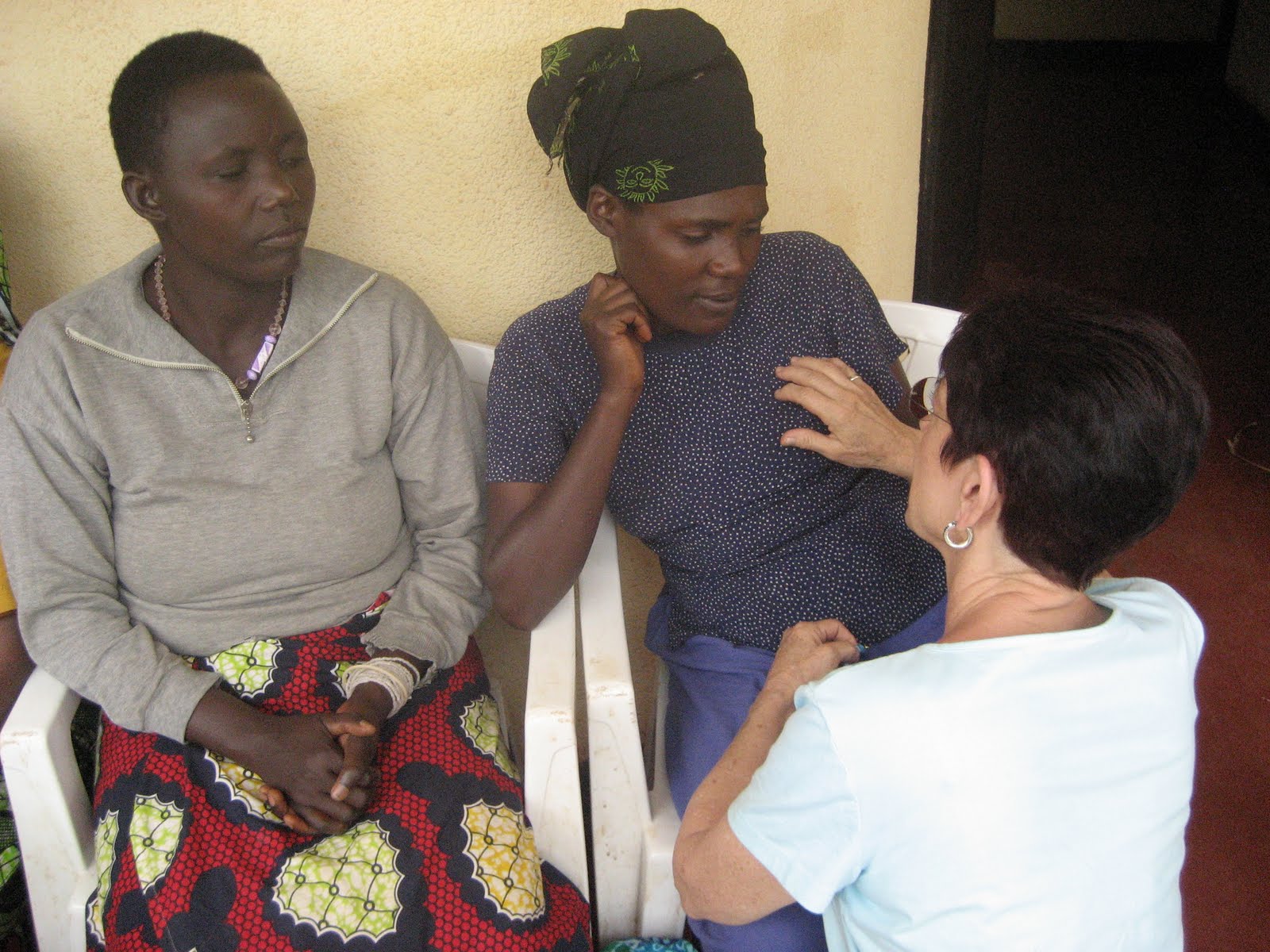
Finally, the female members of the team spent a memorable day with the 35 women that PFR serves. These women are widows of the 1994 Rwandan genocide, during which many were also violently raped and as a consequence contracted HIV/AIDS. They now lead an extremely difficult life, having to support children alone, cope with their illness, and grapple with past memories of the genocide. It is all too easy for these women to blame themselves for what happened to them during 1994 and so this was the issue the IRM team addressed. Using their own personal stories, Bible teachings, and symbolic gestures, Arlene, Tanya and Pastor Dorothea showed the women their worth, stressed that they were not to blame for what had happened to them, and showed the greatest compassion when explaining that whilst they understood how hard life was for these women, at the end of the day, they were blessed to be alive, they all faced the same challenges, and the best way of overcoming these was to work together and to share their experiences. It is difficult to put into words the effect that this had on everybody involved, to use the team’s own words, the experience was overwhelming.

Tanya blesses one of PFR’s widows before giving her a ribbon that symbolises her worth. The women are also given a spare ribbon to give to another woman that they love and admire.

IRM strongly believes that faith must be put into action, and they proved this by not only donating Bibles within the prisons but also providing the widows with Bibles, hand-sewn shopping baskets (made by their church at home), and a hot meal.

The PFR women admire their new shopping bags

IRM continue to be a source of great hope to PFR and all those we work with. We hope that on their next trip they may have the opportunity to visit more prisons, and expand their work into other areas including PFR’s street children, and imprisoned mothers. PFR thanks the IRM team for all their dedication and support.

Friday, 11 June 2010

A New Opportunity for the PFR Children


Prison Fellowship Rwanda has for the past three years served 85 children ranging in age from 3 to 26 years. These children fall into three different categories: Children who live on the street without any external care, children who have only one parent either because the mother or father is in prison or died in the 1994 genocide, and children who are vulnerable (live in extreme poverty with their families). Despite their different backgrounds all these children share a common story. All live in extreme poverty, normally on the streets of Kigali. All dropped out of school at a young age as they could not afford to pay school fees. And all dream of a building a better future for themselves.

With the help of our US partners, Mustard Seed, since April these children have been receiving an increased number of hot meals, drinks, counselling and Bible teachings. Previously PFR could only afford for these children to visit the PFR office once or occasionally twice a week. Now they come three times a week! Furthermore, Mustard Seed has generously provided health insurance for the children for 2010 ensuring that when they are sick, they can receive medication that they could not previously afford.


The children listen to Bible teachings in the PFR garden

By spending just a few afternoons with these children it becomes clear how determined they are to continue their education. They try hard to learn English and show off their maths skills in exercise books they have found. They listen ardently to Bible teachings and enthusiastically participate in recreational sports. When talking to any one of them you will hear a similar dream, that of wanting to go back to school and then to find a job that would enable them to rise above the extreme poverty they now live in.


One of the youngest girls takes the opportunity to read some notes aloud in English

PFR is hopeful that this opportunity may have arrived for some of the older children. Amizero Training Centre offers six month, hands-on, vocational training courses in studies such as Mechanics, Carpentry, and Fabrication. These courses would teach the children the skills needed and reward them with the qualifications necessary to find a job. The courses start in September 2010 and so there is now an urgent need for funding. PFR are currently working closely with partners Douglas and Susan Milton towards this end.


Hikizimana Celeste considers not being able to go to school his only current problem despite having many other social issues. He dreams of going back to school as he says it would make his life more meaningful, he hopes that God will provide him the opportunity to make a better future for himself.

To send one child on a six month training course would cost US $593 in school fees and US $176 for school materials, totalling US $769. Unfortunately, school fees in Rwanda are very expensive and the government offers little support, but this $769 could completely transform a child’s life, enabling them to support themselves, family members still living and even the younger street children. In the grand scheme of things, this $769 could prevent these children, many of which have witnessed incomprehensible violence during the 1994 genocide, from falling into drug use, prostitution, or petty crime. PFR’s long-term vision is to establish a comprehensive care housing establishment for the 85 children that they serve, but for now, please show your support in the next step of their journey and help give them the opportunity to better themselves through an education that was made inaccessible to them through no fault of their own. To donate or get involved, please visit our website visit at www.pfrwanda.org or email us: info@pfrwanda.org.

Friday, 4 June 2010

Success in Kimonyi Reconciliation Village

Over the past five years, with the help of our partner Norwegian Church Aid (NCA) PFR has built over 438 homes in five reconciliation villages throughout Rwanda in an initiative entitled the Umuvumu Tree Project. These villages are a place for ex-combatants, ex-prisoners, and genocide survivors alike to live together again in peace.

PFR emphasizes the importance of ‘practical reconciliation’, the idea that true reconciliation can only be achieved through social and economic development, without which tensions can fester. PFR therefore not only provides houses, but also agricultural projects and education. Ntirenganiya’s story below is a real testament to the positive transformations occurring within these villages.


Proud Ntirenganiya feels ‘blessed to be able to study again’

Ntirenganiya’s education was halted by the 1994 genocide, he was only 13 years old and still in Primary 1. When the genocide ended, he longed to continue his education but did not have enough money to pay for even the most basic of school fees. Three months ago, Ntirenganiya became a member of the Kimonyi reconciliation village and began attending literacy classes. He says: ‘I have already noticed many benefits in my life. I can now go to the market and sell things and I can now make financial transactions, understand the concepts of business better from basic math. This is already helping me become more successful in my daily life.’

It is not always easy, Ntirenganiya explains that he finds Mathematics, and particularly multiplication very challenging but with the help of their proud teacher, Thomas, the class continues to steadily improve. Thomas demonstrates the commitment of the class to their studies when he explains: ‘they are so eager to learn, and therefore they are always punctual. They work very hard to attend class regularly.’


Thomas enjoys teaching a class full of dedicated and willing students

Ntirenganiya’s educational development is only a small part of a much bigger picture. He describes living in the village like living in a family and says: ‘they accept you as you are. There are some hardships still but not like before in other places where I was living. Where I used to live, nobody could talk about reconciliation, but now we talk about it and feel it every day. Unity feels normal.’

The reconciliation villages built by PFR and NCA create space for people to live, work, and learn together, allowing reconciliation to occur on many different levels. Education is a vital part of this process because, as demonstrated by Ntirenganiya’s story, even a basic education can drastically improve daily lives. Education provides the grounding for future economic development and when people no longer need to worry about providing for themselves and their families, they can concentrate on their relationships with each other and with God.

The students of Kimonyi Literacy Class have even been asking for an increased number of lessons and want to expand the class from a six-month class to a full year, a sure sign of the benefits these classes provide. If you would like to get involved or make a donation towards this expansion please visit our website at www.pfrwanda.org or email us: info@pfrwanda.org.